Where does a mini-split even go in a house with no ductwork
Old Santa Fe walls were built for thermal mass, not moving air, so a heating and cooling system here has to work with that instead of against it.
September 3, 2026 · 3 min read
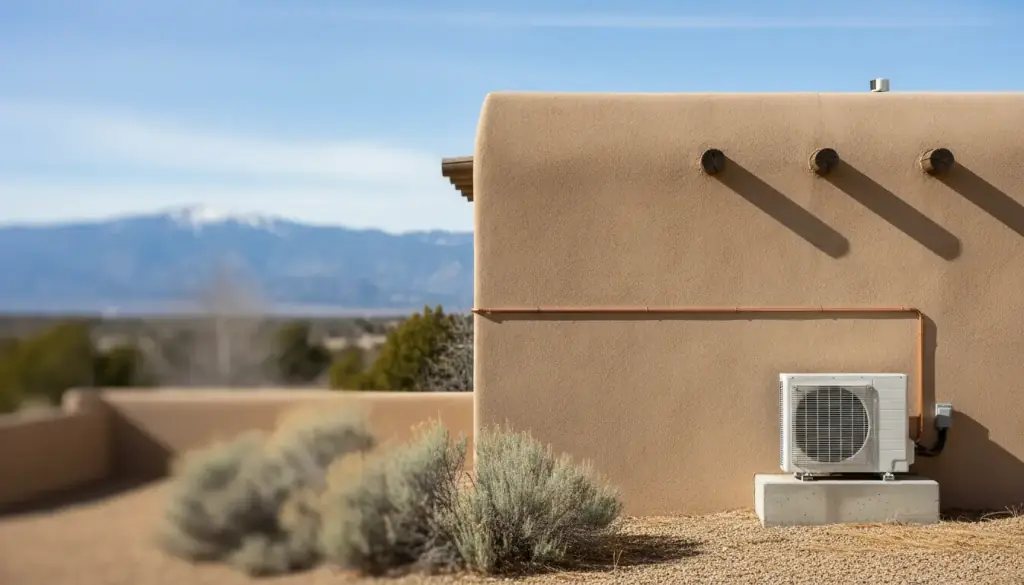
A lot of Santa Fe homeowners call us with the same problem stated three different ways. The back bedroom is always cold. The kiva-fireplace room never holds heat. The addition off the kitchen turns into an oven every July. Different rooms, same root cause: the house has no ductwork to speak of, and cutting a duct chase through two-foot adobe or thick stucco-and-frame walls is either impossible or expensive enough that nobody wants to do it just to fix one room.
Why these houses were never built for ducts
Traditional adobe construction relies on mass, not airflow. Thick earthen or block walls soak up heat during the day and give it back slowly at night, which is part of why old Santa Fe homes stay comfortable through big daily temperature swings without much mechanical help at all. Forced-air systems assume the opposite: a network of sheet-metal or flex-duct runs threading through joist bays and stud cavities, moving conditioned air room to room. Vigas and packed-earth walls do not have joist bays or stud cavities. Retrofitting ducts into a house like that usually means dropped ceilings, furred-out walls, or soffits that eat headroom and change the look of rooms people bought the house for in the first place.
What a ductless system does instead
A ductless system, sometimes called a mini-split, skips the duct network entirely. One outdoor condensing unit connects to one or more small indoor units through a refrigerant line set that runs through a hole in the wall a few inches across, not a chase big enough to walk a dog through. Each indoor unit heats and cools the room it's mounted in, independently of the others. That's what people mean when they say ductless creates zones: the office can run cool while the bedroom runs warm, and neither one is fighting the other through a shared duct trunk.
For a house built in sections over decades, which describes a lot of Santa Fe property, that zoning is not a luxury feature. It's usually the only way to get even, controllable comfort into an add-on room without tearing into the older part of the house next to it.
The part nobody thinks about until it's a problem: where does the outdoor unit go
This is where a ductless install on a historic-district street in Santa Fe gets genuinely different from one in a subdivision. The outdoor condenser needs clearance to breathe, a stable pad, and a reasonably short run back to the indoor head. It also needs to not look like an appliance bolted onto a wall the city has opinions about. On streets governed by historic-district design review, visibility from the street, screening, and placement relative to the front facade all matter in ways a lot of installers never think to ask about until the permit gets kicked back.
- Side or rear yard placement keeps the unit off sightlines from the street where design guidelines are strictest
- A low garden wall, coyote fence panel, or planting bed can screen a condenser without blocking its airflow
- Line-set runs get planned to avoid cutting through a wall face that faces the street or a protected elevation
None of that is guesswork. It's a site visit, a look at where the walls are load-bearing versus not, and a conversation about what the review board in that particular district actually wants to see before equipment goes on an order form.
One head, or several
A single-zone system, one outdoor unit paired with one indoor head, makes sense when there's one problem room. A multi-zone system ties several indoor heads back to one larger outdoor unit and is more common when a whole house needs zoning done at once, or when a homeowner wants to phase the project room by room over a couple of years without replacing equipment they already paid for. Either way, sizing has to be done per room, not per house, because a mini-split that's oversized for a small adobe bedroom will short-cycle and never dehumidify properly, and one that's undersized for a big open great room will run constantly and still not keep up on the hottest afternoons.
If you've got a room in your house that's always the wrong temperature and you've been told the fix means tearing out a wall, it's worth getting a second opinion first. Call Insight Mechanical at (505) 469-1421 and we'll set up a free in-person estimate, usually within two business days, and take an honest look at what your specific house actually needs.
Insight Mechanical — (505) 469-1421
Call (505) 469-1421More articles
Why a furnace sized for Albuquerque is wrong for Santa Fe
Elevation changes the physics your equipment is working against, and a system sized at sea level or even a thousand feet lower will not perform the way the spec sheet promises up here.
What it actually looks like to replace an old boiler with a tankless combi unit
Replacing radiant heat and a hot water tank with one tankless combi unit is a bigger job than swapping an appliance, and it helps to know what the process actually involves before it starts.